
Practical job planning
3D Print Batch Cost per Part: Plate and Order Allocation
Cost a batch from its sliced plates, then add the work that happens once per order. Five parts on two plates are not five independent machine runs. First find the order total; only allocate an average when the parts and intended quantity make that average meaningful.
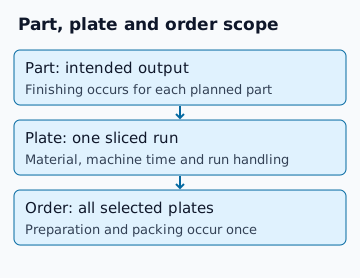
Shared fictional job: five identical parts, two plates
Plate A contains three identical parts and has a complete 90 g consumption estimate and four-hour run. Plate B contains two of those parts, with 70 g and three hours. Both run once. These are hypothetical inputs, not slicer observations, measured power or market rates.
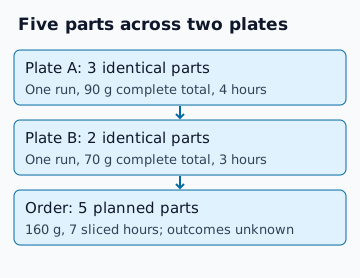
Use 24 currency units (CU) per kilogram, 120 W average power and 0.30 CU/kWh. Machine allowance is 2 CU/hour, explicitly excluding energy. Labour is 18 CU/hour. Preparation takes 20 minutes once; each run has 10 minutes of handling; each planned part takes five minutes of finishing. Packaging is 1.60 CU for the order.
| Component | Hypothetical calculation | CU |
|---|---|---|
| Material | 0.160 kg × 24 | 3.84 |
| Energy | 7 h × 0.120 kW × 0.30 | 0.252 |
| Machine | 7 h × 2, excludes energy | 14.00 |
| Preparation | 20/60 h × 18, once | 6.00 |
| Plate handling | 2 × 10/60 h × 18 | 6.00 |
| Finishing | 5 × 5/60 h × 18 | 7.50 |
| Packaging | Once per order | 1.60 |
| Total | No extra waste, shipping, tax or failure budget | 39.192 |
The allocated average is 39.192 / 5 = 7.8384 CU. This spreads all
selected job costs across five identical intended usable parts. It is neither
an exact individual cost nor the marginal cost of adding one more part. Actual
accepted, rejected and missing results must be recorded separately after
production; the plan does not establish delivered quantity.
Five independent runs change the scope
Keeping preparation at 20 minutes but incurring five ten-minute handling tasks makes handling 15 CU instead of 6 CU. That alone adds 9 CU. Material and duration cannot safely be copied from the two-plate total: slice each new arrangement. The comparison isolates one scope effect, rather than claiming five independent runs cost exactly 48.192 CU.
Changing quantity requires another slice
Suppose the customer changes five parts to six. A fourth part may fit Plate A, a third may fit Plate B, or another plate may be needed. Check the layout, slicing profile and complete estimates for the chosen arrangement. Sharing a purge tower, travel changes and partial plates can change the per-part average. Do not multiply seven hours by 6/5 and call 8.4 hours a slicer result.
Repeating the unchanged Plate A twice means six planned parts, 180 g and eight sliced hours under that explicit repeat assumption. Its handling occurs twice. Shared preparation still occurs once if no new preparation is required. A different revision, material or approval step can add preparation again as agreed work.
Mixed parts stay at order level
A bracket and four caps can have different material, machine time and finishing needs. A mass ratio is not an allocation method for shared machine time or administration. The job calculator therefore offers a total, with per-part average only after confirming identical parts. For mixed work, retain plate/material rows and agree any allocation outside this first version.
Retain a reproducible job record
- Record requested quantity and the exact revision, material and profile with each plate.
- Enter complete consumption separately for different spool price bases; identify genuinely unreported extra material.
- Record run handling, once-per-order work and per-part finishing in their own scopes.
- Document the selected failure budget and any costs already included in rates.
- Review the total and export the job inputs before making a pricing decision.
Use Several plates / one job in the cost calculator. Its fictional example reproduces these inputs. Production methodology owns rate and uncertainty choices; the pricing guide owns margin, fees and the quote. JSON retains full precision; print and PDF retain the same input basis. Rounded averages may not multiply to the displayed rounded total.
FAQ
Can I divide total job cost by quantity?
For identical planned usable parts, it is an allocated average. Mixed parts require an explicit allocation method; the calculator keeps their total at order level.
Can I scale print time with quantity?
Only an unchanged explicitly repeated run uses repeated duration. A changed plate arrangement needs re-slicing; linear scaling is not a new slicer estimate.