Recognise a finding, download a small known control and try it in the tool. Each example separates generated geometry from observed software output and the decision you still need to make.
All models here are original InspectMesh mathematical geometry, available to download, modify and redistribute with attribution to InspectMesh. They contain no customer data. Slicer exports are preview-only records, never instructions to run a printer. No physical print success is claimed.
Read methods and processing for analysis scope and local versus optional server actions. The linked guide owns the full explanation; these cards help you choose a control.
Size / units
Size and units
Original explanatory diagram. Use the files to reproduce the reported observation.
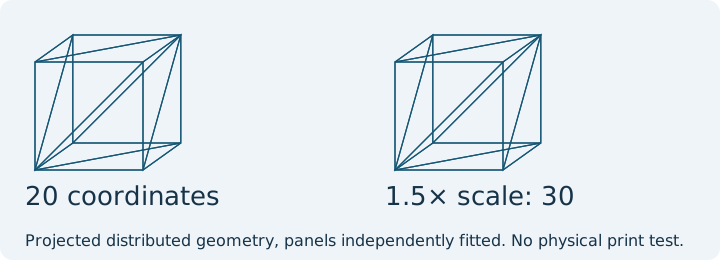
What changes when 20 coordinates mean inches, or are scaled to 150%?
Known geometry: A closed cube has 20-coordinate spans and 12 triangles.
Software observation: Under millimetres: 20 mm and 8,000 mm³. Under inches: 508 mm. Scaling by 1.5 exports 30-coordinate spans and 27,000 mm³ under millimetres.
Check a known dimension in the receiving application. STL does not acquire unit metadata.
Original explanatory diagram. Use the files to reproduce the reported observation.
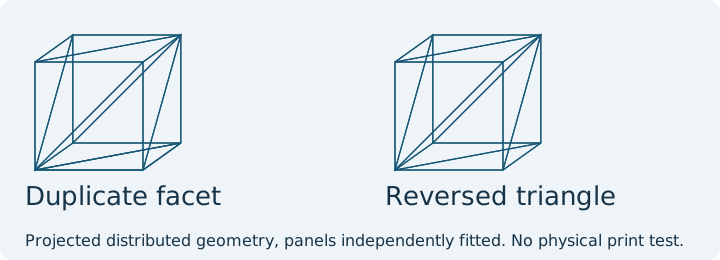
Can edge checks distinguish a duplicate from a reversed triangle?
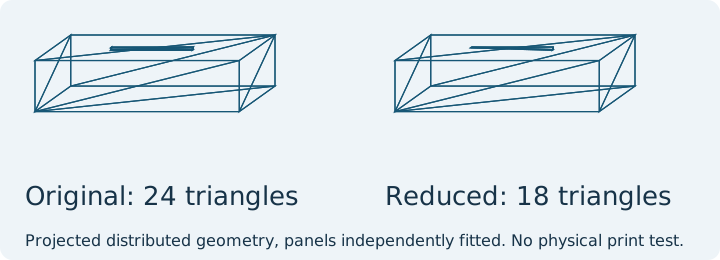
Known geometry: Separate copies add one exact facet, reverse one triangle, or change only one stored normal vector.
Software observation: The duplicate has 13 triangles, one duplicate and three over-shared edges. Reversed winding has 12 triangles and three edge-direction conflicts. Changing only the normal vector yields zero winding conflicts.
Preserve the original and correct a copy in CAD or a mesh editor. Consistent edge directions do not establish the intended outside.
Original explanatory diagram. Use the files to reproduce the reported observation.
Do zero open edges rule out intersecting solids?
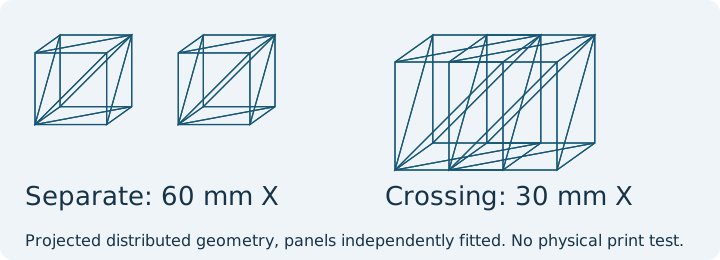
Known geometry: Two closed 20 mm cubes are separated by a 40 mm translation or overlap with a 10 mm translation.
Software observation: Both have two components, zero open edges and zero over-shared edges. Bounds are 60 or 30 × 20 × 20 mm. Volume is withheld.
Inspect intentional parts and crossing surfaces in the source design. InspectMesh does not detect self intersections; touching is also different from a boolean union.
Original explanatory diagram. Use the files to reproduce the reported observation.
Why can sampled thickness and slicer paths tell different stories?
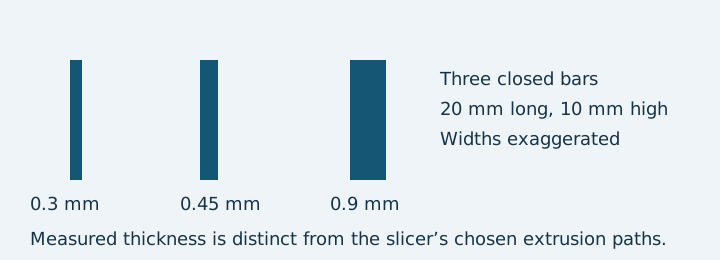
Known geometry: Three bars are 0.3, 0.45 and 0.9 mm wide, 20 mm long and 10 mm high.
Software observation: Retained PrusaSlicer 2.9.6 second-layer previews show four extrusion moves for Classic and six for Arachne, at three bar positions. These are software exports, not prints.
Review measured and unmeasured rays and the native slicer preview. Preview-only G-code must not be run on a printer. No universal minimum wall is established.
Original explanatory diagram. Use the files to reproduce the reported observation.
How do resources, placements and declared units affect the STL export?
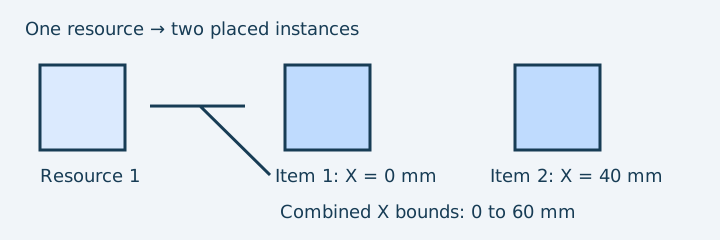
Known geometry: One cube resource is placed once or twice. A separate inch package places a one-inch cube at X = 2 inches.
Software observation: Resolved builds have 12 / 24 triangles and 20 / 60 mm X spans. Reopened inch conversion has 12 triangles, 25.4 mm spans and X = 50.8 to 76.2 mm.
Keep the original package/project. STL loses declared units, build identity, colours, materials and project settings; unsupported extensions are not validated.
Original explanatory diagram. Use the files to reproduce the reported observation.
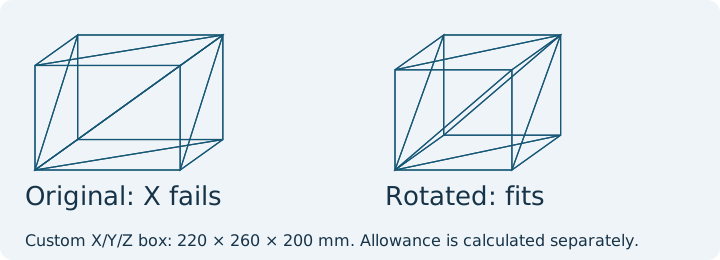
Can a rotation fit after allowing space for a brim?
Known geometry: A rectangular 250 × 210 × 180 mm envelope is tested against a custom 220 × 260 × 200 mm box (X / Y / Z).
Software observation: Original orientation fails X. Rotation to 210 × 250 × 180 fits nominally. A 5 mm allowance on each X/Y side gives 220 × 260 × 180, exactly at two limits; 6 mm gives 222 × 262 × 180 and fails.
Confirm usable slicer space, excluded zones, supports and clearance. These hypothetical allowances are not a support strategy or general collision check.