File diagnosis with owned examples
Self Intersections and Non-Manifold Edges Are Different Checks
A non-manifold edge concerns how faces are connected. A self intersection concerns where surfaces cross in space. A mesh can pass an edge-incidence check while its triangles still intersect. InspectMesh collection review does not detect self intersections; zero non-manifold edges must not be presented as an intersection clearance.
Two independent questions
| Condition | Simple example | What to inspect |
|---|---|---|
| Boundary edge | A face removed from a closed cube leaves four boundary edges | Missing surface and intended opening |
| Over-shared edge | A duplicate cube triangle makes its three edges belong to three faces | Connectivity and exact duplicate faces |
| Intersecting surfaces | Two closed cubes offset 10 mm on X overlap despite each being closed | Spatial crossings, intended union and cavity semantics |
| Vertex-only contact | Two shells meet at a point | Whether a meaningful solid connection exists, beyond edge counts |
Boundary edges have one incident triangle; an ordinary closed-surface edge has two. The collection non-manifold edge count flags more than two. Broader manifoldness also includes vertex neighbourhoods, so passing this edge-only screen is narrower than proving a manifold solid.
Reproduce the crossing-shell counterexample
Download two overlapping closed cubes. Each is 20 mm wide; the second is translated 10 mm on X. Expected combined bounds are 30 × 20 × 20 mm, with two connected shells and zero boundary or over-shared edges after exact-coordinate welding. The surfaces intersect even though these counts are zero. The collection report withholds volume because shell interpretation is unresolved.
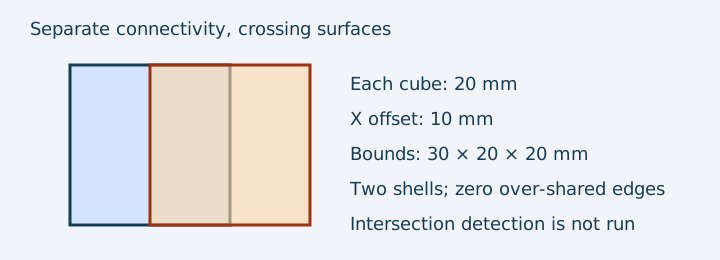
This control demonstrates crossing shells; intersections can also occur within one connected shell. No one-shell self-intersection detector is claimed. Duplicate removal cannot resolve a crossing between unrelated triangles merely because their faces occupy some of the same space.
Practical inspection sequence
- Run collection review and retain topology counts and method limits.
- Inspect the crossing region in the viewer or a mesh editor. A cross-section can reveal interior surfaces but is a visual aid, not an exhaustive test.
- Check the native CAD Boolean/assembly intention: union, separate movable parts or an internal cavity?
- Use a source-CAD solid or mesh editor with an explicit intersection check when required; review that tool/version’s limitations.
- Export a corrected copy, compare revisions and inspect the affected slicer layers.
Stop before guessing the intended solid
If union would close a deliberate cavity or merge separate moving pieces, ask the designer. A successful slice is evidence of that slicer’s chosen interpretation, not proof that it matches intent. Return to CAD when the crossing involves functional surfaces or a missing Boolean result.
The non-manifold explainer classifies connectivity patterns; the repair guide chooses a corrective workflow. This page separates the diagnostic tests. The 3MF mesh requirements provide a normative solid-mesh reference, reviewed 7 October 2026. Fixture outcomes come from owned geometry tests, not physical prints.
FAQ
Does zero non-manifold edges rule out intersections?
No. Edge incidence measures connectivity; triangles can cross without sharing mesh edges. Collection review does not run self-intersection detection.
Should overlapping shells always be merged?
No. Determine the intended union, cavity or separate moving parts before changing the design. Return to source CAD when intent is unclear.