
Practical job planning
3D Print Labour Cost and Post-processing
Charge hands-on work according to when it actually occurs. Seven hours of unattended machine time does not automatically mean seven hours of labour. Preparation may be shared, handling may repeat with each run, and finishing may scale with intended parts.
Use task scope before a rate
| Task | Scope | Input to retain |
|---|---|---|
| File intake, slicing, agreed administration | Once per order when shared | Active minutes and revision/profile scope |
| Setup, unloading and run inspection | Each planned run where incurred | Minutes per run and repeat count |
| Support removal, finishing or inserts | Each applicable planned part | Active minutes per part and agreed process |
| Packing, delivery or consumables | Declared order allowance | Included amount; no hidden repeat multiplication |
The job calculator uses one editable labour rate for the selected job. If materially different work needs different rates, retain a separate scoped estimate and include it deliberately as an order extra rather than implying all work has the same market value. No universal rate or finishing duration is supplied.
Worked active-work arithmetic
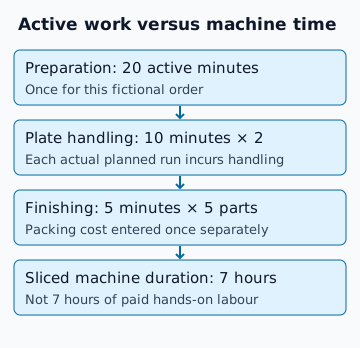
For the fictional five-part, two-plate job, a hypothetical 18 CU/hour rate gives 20/60 × 18 = 6 CU for preparation; 2 × 10/60 × 18 = 6 CU for plate handling; and 5 × 5/60 × 18 = 7.50 CU for finishing. Active labour totals 19.50 CU across 65 minutes. Seven sliced machine hours are priced separately. Packaging is 1.60 CU entered once and is not another labour duration.
If five independent runs each require the same ten minutes of handling, handling becomes 15 CU. Preparation remains 6 CU only if it is still shared. Repeated handling does not justify inventing a linear material or machine-time estimate for the changed arrangement.
Define finishing and inspection before accepting the job
Agree what the quoted work includes: support removal, surface acceptance, inspection points, insert installation, assembly or a representative fit coupon. Record the supplier/process instructions and who supplies hardware. An estimate of hands-on minutes does not prescribe a hazardous finishing method, guarantee fit or certify the finished part.
For a coupon iteration, list file preparation, sliced production and measurement/installation work as distinct tasks. Agree the number of iterations included and what triggers a revised quote: changed CAD, another counterpart, a different material or a new profile. Preserve failed or rejected results as outcomes; a planned coupon is not an accepted production piece.
Avoid duplicate labour in allowances
Ask whether a machine or overhead rate already includes routine supervision or handling. If so, remove the equivalent separate labour entry or use a rate that explicitly excludes it. Likewise, per-part finishing should not be charged again inside run inspection when both describe the same task. A failure budget should explain which cost scope it covers.
Active work is different from elapsed availability
Cooling, curing, a queue gap or waiting for customer approval can lengthen lead time without occupying hands-on labour for the whole interval. Enter any actual active work separately, and take process waiting durations from the relevant supplier guidance or your explicit input. The lead-time guide owns the elapsed schedule.
Record and revise the estimate
- Resolve quantity, revision, material and acceptance requirements.
- List active tasks and mark order, run or part scope.
- Enter user-estimated minutes and rate in the existing job calculator.
- Retain the report and revise assumptions when the agreed work changes.
Prusa separates preparation/manpower from machine operation in its cost methodology article, published in 2020 and reviewed here 10 October 2026. Its historical rates and examples are context, not current recommended prices. InspectMesh examples are independent hypothetical arithmetic. Margin and selling fees belong to the pricing decision after the work has been costed.
FAQ
Is unattended printing charged as labour?
Only active work you actually include belongs in labour. Machine time and elapsed waiting are separate scopes.
Should preparation repeat for every part?
Only when preparation is repeated. Shared preparation occurs once per order; run handling and per-part finishing have their own repeat rules.